Sarcopenia: age-related muscle loss and how to tell if it is happening to you
TechNSports Team · · 7 min read
Muscle is not lost overnight. It slips away quietly, little by little, over years, and most people do not notice until the stairs are more tiring, jars are harder to open, or the scale says nothing has changed while their clothes tell a different story. Scientists gave that process a name: sarcopenia. The good news is that it can be measured, it can be slowed and, to a large extent, it can be reversed. Here we explain what it is, why it happens and what the numbers say.
What is sarcopenia?
Sarcopenia is the progressive, generalized loss of muscle mass, strength and physical function that comes with age. The most widely used European consensus in the world, EWGSOP2 (Cruz-Jentoft and colleagues, in the journal Age and Ageing, 2019), defines it by putting strength at the center: the first thing assessed is not how much muscle you have, but how much strength you produce. A weak muscle predicts health problems better than a small one.
That same consensus set concrete reference points. Handgrip strength below 27 kilograms in men or 16 kilograms in women is considered low. A walking speed below 0.8 meters per second is considered slow. They are simple numbers, and that is exactly why they are so useful: they can be measured in minutes and compared over time.
At what age do you start losing muscle, and how fast?
Earlier than most people imagine. Starting at age 30, an adult who does not strength train loses on average 3 to 8 percent of their muscle mass per decade, according to the classic review by Volpi and colleagues (2004). After 60 the process speeds up, and the Cleveland Clinic estimates that the loss can reach as much as 8 percent per decade, with the fastest pace between ages 65 and 80.
Put another way: a 50-year-old may already have lost between 6 and 16 percent of the muscle they had at 30, without ever having been sick and without the scale giving it away. Total weight can hold steady because fat tends to take the place that muscle leaves behind. That is why weighing yourself is not enough: you need to know what that weight is made of.
Why do we lose muscle with age?
The mechanism has several parts that add up. The first is what is known as anabolic resistance: over the years, muscle responds less to the stimulus of the protein you eat and the exercise you do. The same meal and the same workout build less muscle at 70 than at 30, so the stimulus has to be more deliberate.
The second part is neurological. With age we lose motor neurons, the nerve cells that tell muscle fibers to contract. When a motor neuron dies, the fibers that depended on it are left without a signal and atrophy. The third part is hormonal: levels of the hormones that support building muscle tissue decline gradually. The fourth, and the most modifiable of all, is disuse. Muscle is an expensive tissue to maintain, and the body cuts what is not used. Every week of inactivity confirms to the body that the muscle is surplus.
How common is sarcopenia in Mexico?
More common than the conversation suggests. An analysis of Mexico’s National Health and Nutrition Survey (ENSANUT 2012), published by Espinel-Bermúdez and colleagues in 2018 with data from 5,046 Mexican adults aged 60 or older, found a sarcopenia prevalence of 13.3 percent, plus another 8.7 percent in the earlier stage known as presarcopenia. In other words, a little more than one in five older Mexican adults was already on that path.
It is worth underlining what that number does not say: sarcopenia does not appear at 60. At 60 it is detected. The process had been running for decades, and the earlier decades are precisely the window where the most can be done.
Why does grip strength matter so much?
Because it turns out to be one of the most powerful and least expensive predictors of health there is. The PURE study (Leong and colleagues, The Lancet, 2015), which followed 139,691 people in 17 countries for four years, found that every 5 kilograms less of handgrip strength was associated with a 16 percent higher risk of death from any cause. In that study, grip strength predicted mortality better than systolic blood pressure.
The explanation is logical: the hand is not special in itself, but its strength reflects the state of the whole muscular system. A firm grip usually means firm legs, a firm back and a body that has kept being used. That is why the EWGSOP2 criteria start right there, with a dynamometer.
How do you measure muscle mass without guessing?
With technology that separates weight into its components. A professional-grade bioimpedance analysis, such as InBody’s, estimates how many kilograms of skeletal muscle mass you have and how they are distributed by segment: arms, legs and trunk. A 3D body scan adds shape: circumferences and volumes that show where your body is changing. Grip strength, measured with a dynamometer, completes the picture with the data point that studies identify as the most revealing.
Each measurement is a point-in-time reading, a snapshot of the moment. The value appears when you repeat it under the same conditions at regular intervals: that is when the numbers stop being curiosities and become a trend. Knowing that your muscle mass went up 400 grams in two months, or that your grip dropped 2 kilograms in a year, is information you can actually act on.
What can you do to keep and rebuild muscle?
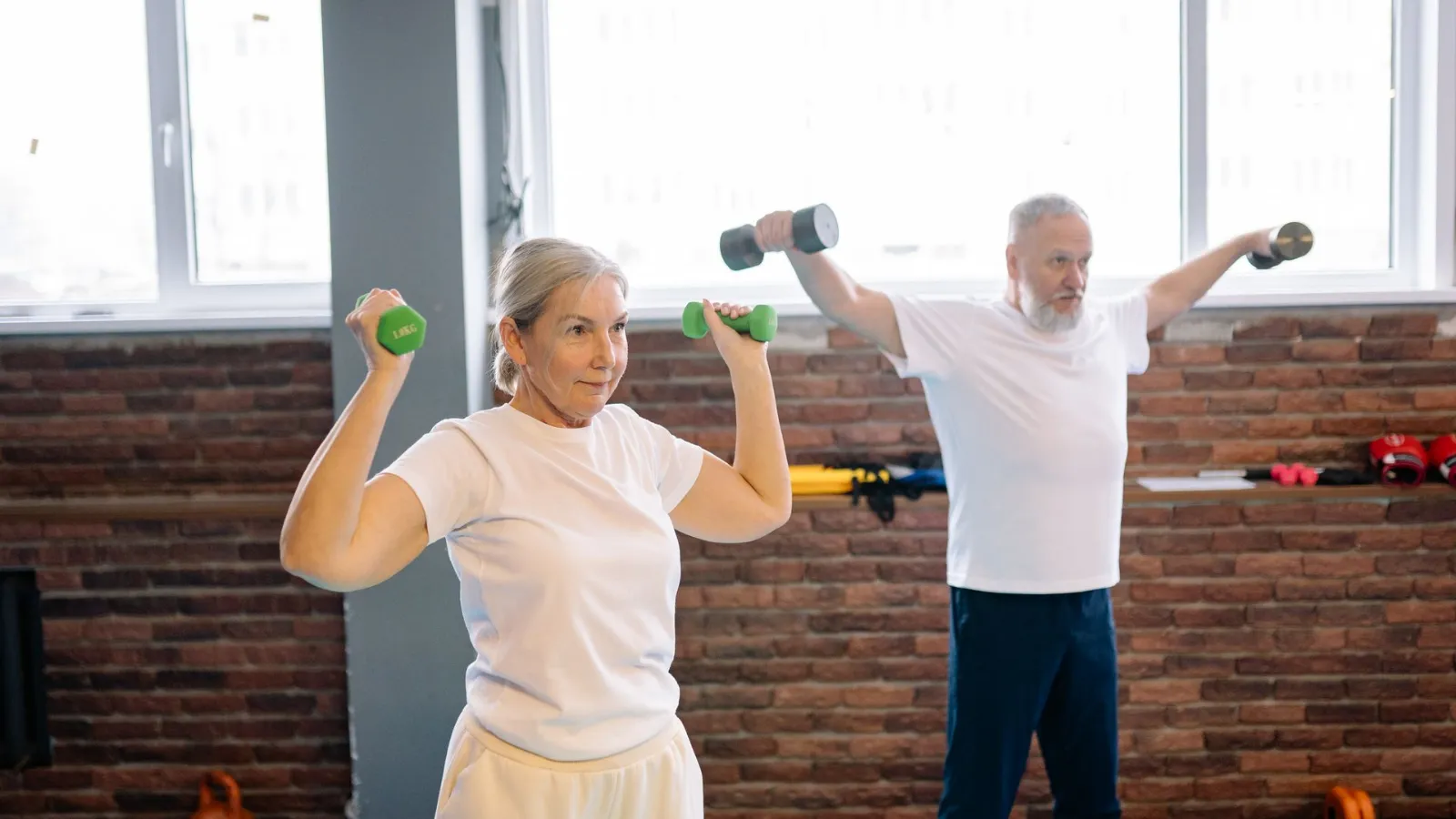
Two things, and both are well documented. The first is strength training. The World Health Organization’s physical activity guidelines (2020) recommend that adults get 150 to 300 minutes a week of moderate aerobic activity, plus muscle-strengthening exercises for the major muscle groups at least 2 days a week. That second component is the one most people skip, and it is precisely the one that speaks to the mechanism of sarcopenia: muscle that is challenged gets the signal to stay.
The second is eating enough protein. The PROT-AGE study group (Bauer and colleagues, 2013) recommends that healthy older adults get 1.0 to 1.2 grams of protein per kilogram of body weight per day, above what is usually recommended for younger adults, precisely to offset anabolic resistance. For a person who weighs 70 kilograms, that means 70 to 84 grams of protein a day, spread across the day.
Neither strategy requires anything extreme. They require consistency and a way to verify that they are working, because what is not measured stays at good intentions.
Start by knowing where you stand today
If you want to know how much muscle mass you have, how it is distributed and how much strength you produce, at TechNSports we measure it precisely: professional bioimpedance, a 3D body scan and grip strength, measured the same way every time so the numbers really mean something. A scan session gives you your starting point, and the ones that follow show you whether you are heading in the right direction. Book your scan session at technsports.mx and see your numbers clearly. If you would rather handle this on your own, we respect that too.
This article is educational wellness content and does not constitute medical advice. TechNSports performs body composition and strength measurements for wellness and performance purposes; we do not evaluate or treat illnesses. If you have concerns about your muscle or bone health, see a health professional. Sources cited: Cruz-Jentoft et al., “Sarcopenia: revised European consensus on definition and diagnosis”, Age and Ageing (2019); Volpi et al., Current Opinion in Clinical Nutrition and Metabolic Care (2004); Cleveland Clinic, “Sarcopenia” (online resource, 2026); Espinel-Bermúdez et al., analysis of ENSANUT 2012 on sarcopenia in older Mexican adults (2018); Leong et al., PURE study, The Lancet (2015); World Health Organization, Guidelines on physical activity and sedentary behaviour (2020); Bauer et al., PROT-AGE group, JAMDA (2013).
Frequently asked questions
What is sarcopenia?
It is the progressive, generalized loss of muscle mass, strength and physical function that comes with age. The European consensus EWGSOP2 (2019) defines it by putting strength at the center: the first thing assessed is not how much muscle you have, but how much strength you produce.
At what age do you start losing muscle?
Starting at age 30. An adult who does not strength train loses on average 3 to 8 percent of their muscle mass per decade, according to the review by Volpi and colleagues (2004), and after 60 the process speeds up.
How can I tell if I am losing muscle?
By measuring it. A professional-grade bioimpedance analysis estimates how many kilograms of skeletal muscle mass you have and how they are distributed by segment, and grip strength is measured with a dynamometer. Repeating the measurement under the same conditions turns the numbers into a trend.
What can you do to keep and rebuild muscle?
Strength train and eat enough protein. The WHO (2020) recommends muscle-strengthening exercises at least 2 days a week, and the PROT-AGE group (2013) recommends 1.0 to 1.2 grams of protein per kilogram of body weight per day for healthy older adults.