Visceral fat: why it matters more than the number on the scale
TechNSports Team · · 5 min read
The scale gives you a number. That number can’t tell muscle from water from fat, and it certainly can’t tell you where that fat is stored. And that detail, the where, is the one that truly changes your health.
You can be at your “normal weight” and still carry an amount of fat around your organs that no dress or pair of pants will ever reveal. That fat is called visceral fat, and understanding it is probably the most useful thing you can do for your metabolic health this year.
What visceral fat is
Your body stores fat in two very different places. Subcutaneous fat sits just beneath the skin, the kind you can pinch. It is the most visible and, for better or worse, the least dangerous.
Visceral fat is something else. It builds up deep in the abdomen, wrapping around the liver, the pancreas and the intestines. You can’t pinch it because it isn’t at the surface. It is inside, surrounding the machinery that keeps you running.
The difference matters because visceral fat doesn’t sit still. It behaves almost like an active organ: it releases inflammatory substances and fatty acids straight to the liver. Over time, that is associated with insulin resistance, high blood pressure and changes in cholesterol and triglycerides. That is why two people at the same weight can have completely different health risks.
Why the scale falls short
Body weight adds everything together: bone, muscle, water, subcutaneous fat and visceral fat, without separating them. Two scenarios make this clear.
A thin person, with no apparent excess weight, can accumulate enough visceral fat to have a metabolic risk profile. There is even a term for this, one that describes exactly the person who looks thin on the outside but carries fat where it can’t be seen.
The reverse happens too. Someone who strength trains may weigh “too much” according to the charts, but that extra weight is muscle, not fat. Their metabolic risk profile can be excellent.
In neither case did the scale tell you the truth. That is why weight, on its own, is a poor indicator of health.
The signs you can measure today
You don’t need technology to get a first reading. There are two at-home measurements backed by international guidelines.
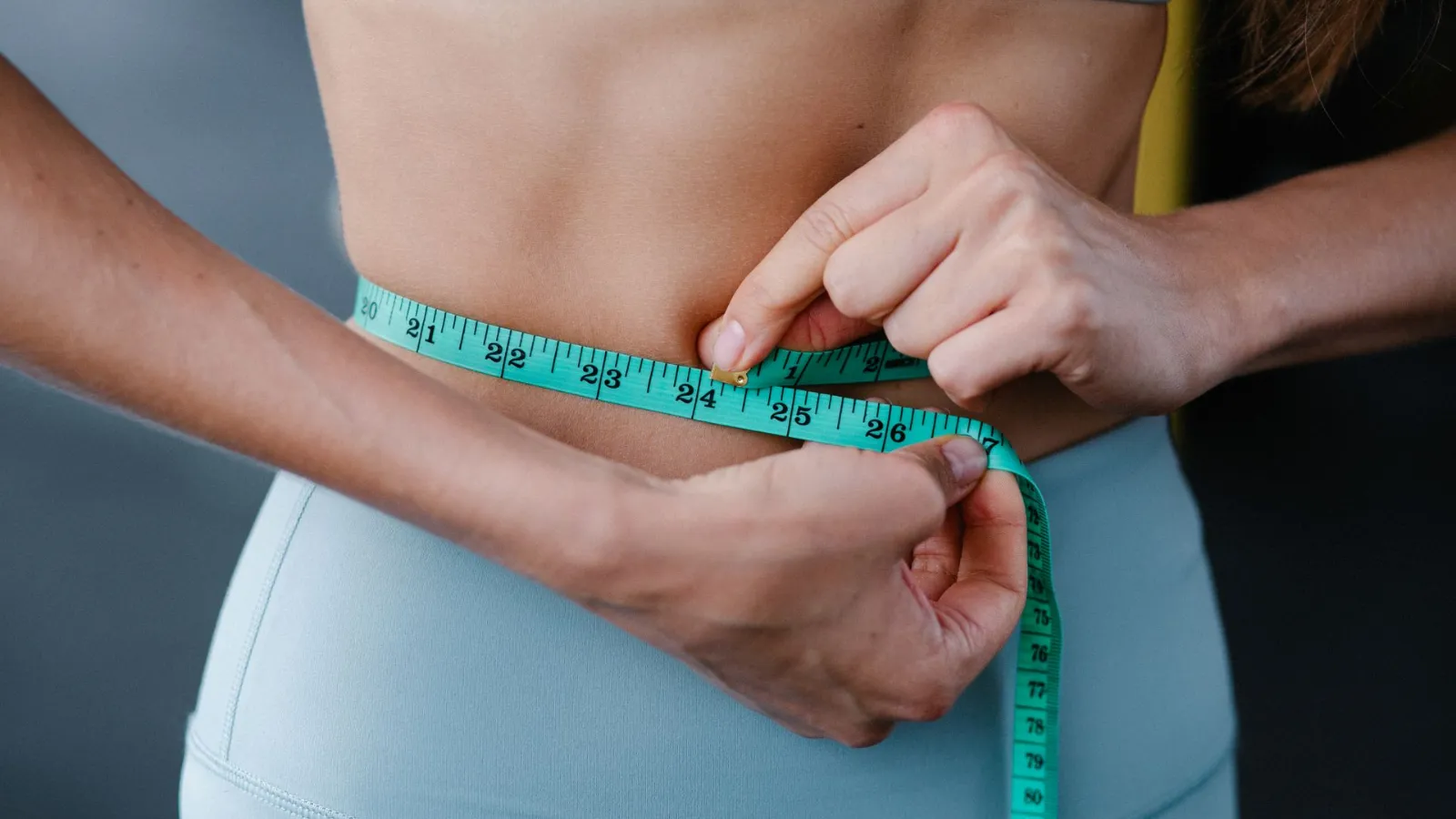
Your waist. Measure at the level of your navel, without pulling the tape tight, after a normal exhale. The International Diabetes Federation, with the cutoffs it recommends for the Latin American population, marks higher cardiometabolic risk starting at 90 cm in men and 80 cm in women (IDF, 2005). These are conservative figures, the ones the IDF says to use in this region until more specific data are available.
Your waist divided by your height. Measure your waist and your height in the same units, then divide. If the result is over 0.5, it is worth paying attention. The rule is easy to remember: your waist should measure less than half your height. Several reviews, such as the meta-analysis by Ashwell and colleagues (Obesity Reviews, 2012), rank it among the most reliable simple predictors of risk associated with abdominal fat.
These measurements are a good first filter. What they don’t tell you is how much of that circumference is visceral fat and how much is abdominal muscle or subcutaneous fat. That is where an at-home reading reaches its limit.
From estimate to real measurement
A tape measure estimates. A body composition analysis measures.
With a body scan and a segment-by-segment analysis, you can separate what the scale lumps together: how much muscle you have, how it is distributed, how much subcutaneous fat you carry and a specific estimate of your visceral fat. Instead of one ambiguous number, you get a map of your body.
And perhaps the most valuable part: by repeating the measurement over time, you see whether what you are doing is working. When someone starts eating better and moving more, the scale sometimes barely moves for weeks, because they are gaining muscle while losing fat. Without a measurement that separates the two, it is easy to give up right when things are going well. With one, you see the real progress and you keep the habit going.
What to remember
Visceral fat, the fat that surrounds your organs, weighs more on your health than the number on the scale. You can get a first reading today with a tape measure: check your waist against 90 cm for men and 80 cm for women, and confirm that it measures less than half your height. If you want to go from an estimate to really knowing how much visceral fat and how much muscle you have, that is where a body composition measurement makes the difference.
At TechNSports, that is exactly what we do: we turn your body’s numbers into something clear, so you know where you stand and what to change. If you’d like to know your body composition in depth, we’ll gladly book your scan session.
This content is informational and educational, and it does not replace an evaluation by your own physician. The figures cited come from international guidelines (IDF, 2005) and from the literature on the waist-to-height ratio (Ashwell and colleagues, Obesity Reviews, 2012).
Frequently asked questions
What is visceral fat?
It is the fat that builds up deep in the abdomen, wrapping around the liver, the pancreas and the intestines. Unlike subcutaneous fat, you can't pinch it because it isn't at the surface.
Why is visceral fat more dangerous than subcutaneous fat?
Because it behaves almost like an active organ: it releases inflammatory substances and fatty acids straight to the liver. Over time, that is associated with insulin resistance, high blood pressure and changes in cholesterol and triglycerides.
How can I tell if I have visceral fat without any equipment?
Two at-home measurements give you a first reading: your waist at navel level, with higher risk starting at 90 cm in men and 80 cm in women, and your waist divided by your height, which should not go over 0.5. They are a first filter; they don't tell you how much of that circumference is visceral fat.
Can I have visceral fat even if I'm at a normal weight?
Yes. A thin person with no apparent excess weight can accumulate enough visceral fat to have a metabolic risk profile. That is why weight, on its own, is a poor indicator of health.